A Nostalgic Reflection on “Assassin’s Fate”. Yes. Nostalgic.
I must admit that it was a great surprise to me, to like the last part of Fitz and Fool trilogy so much, and to mourn after its characters.
I liked the first trilogy about Fitz and I despised the second. The last trilogy is something between to me, perpetuating the previous stereotypes of its setting but also having so many redeeming qualities, such as vivid and memorable universe and well-drawn characters.
Having read third book, I’ve made up a theory.
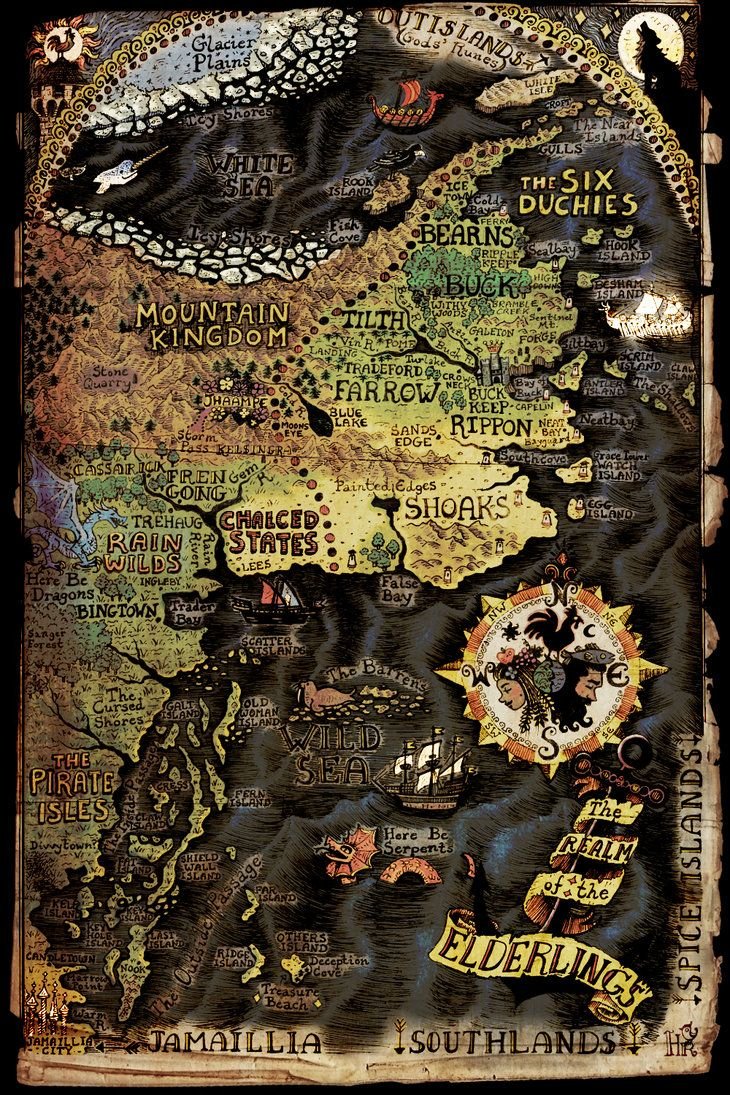
Assassin’s Fate is like an enticement to those who know the Realms of Elderlings only from the books on Farseer dynasty. It offers a broader world and a broader perspective, suggesting that there are entire lands and stories beyond Six Duchies and their cast to be discovered. There are traders, dragon-humans, go-ahead pirate queens and female captains, and there are voices which may sound—at last—completely different from Fitz’s. And the world Hobb has created is certainly worth of exploring, reminding of such realms as Earthsea, where names, ethnics and customs are completely out of our earthly stereotypes and Western-culture well-exploited conventions.
There are additions to the setting, though, which may seem strange to the reader accustomed to particular tropes in Hobb’s writings. In Assassin’s Fate violence and disease occurs, and it occurs on-stage. Frequently. It can be triggering, of course, but I think that those descriptions are woven into on purpose unlike in the previous book where, I would say, some descriptions were unnecessarily prolonged. Also, we get a lot about villains (the masters of Evil! Clerres school) but unlike Prince Regal in the first trilogy, they don’t feel over-drawn and it’s actually quite interesting, to learn about the dynamics between them.
Despite of some brutal fragments, Assassin’s Fate has reassured me that the less Farseers&Six Duchies, the merrier. It has also made me aware that Realms of the Elderlings is a setting where opinions and approaches do change. What is seen as homely by Fitz is perceived as dull or even opressive by his daughter Bee. What Fitz thought on informal relations in Tawny Man trilogy isn’t the same he thinks as he sees young Lant in love. Just as Kristin Lavransdatter in the last volume of her eponymous trilogy, he realizes that no matter social conventions, love is love and youth is youth.
Still, there is one thing—the very core of the plot—which made me triggered. It’s the whole tread of an eye for an eye which seems to be accepted by almost all the “good” characters. We’ve been told in those books that blind hatred is bad, SPOILERS and yet we get such a finale when not only the villains do perish, but also the people whose only fault was living in the same city. SPOILERS Nope. Just nope. What I can only say is that the wisest person in all this havoc is Prilkop, one of the former White Prophets. Also, I can understand that dragons taking part in those events are completely out of our morality. But people should have been a bit more… Reflective. I know that many fantasy books have exactly the same problem with “revenge” plots but I also expected something more nuanced from the final instalment of the entire saga.
Still, Assassin’s Fate was a very positive surprise to me. On the level of technique it wasn’t anything ground-breaking, since Fitz’s and Bee’s narrations sound more or less the same, but the book was simply good. It was about living people, not about over-drawn cartoon puppets. It was about people whose emotions are deep and true. Thus, there is a strange feeling of sadness to it, but also a notion of hope, the belief that we live as long as we are rembered.
If I return to Elderlingsverse, I hope it will be a trip more in the kind of Fitz and Fool than Tawny Man.
Let’s say, then, that for the time being, I give Robin Hobb my credit.

 Left Hand of Fiction