Five… But if I’d count them, there would be more, I’m sure.
Kink Fantasy Instead of Dark Fantasy
Oh, yes. It’s damnably kinky. And it isn’t even about numerous sex scenes. Or about magical rites and hierarchies connected to sexuality on a literal level.
It was to be dark and lush, I’m sure. Male sexual slaves, voluptuous Queens wielding magic, handsome guys as protagonists, decadent courts… But when the world-building is scarce and the male characters are fetishized, what is left isn’t a seductive darkness but a repelling uneasiness.
So, yeah, the main antagonist is a lass who’s been raping her own son and who likes gelding disobedient males. She holds some men as sexual slaves and allows some others to rape and mistreat “weaker” witches.
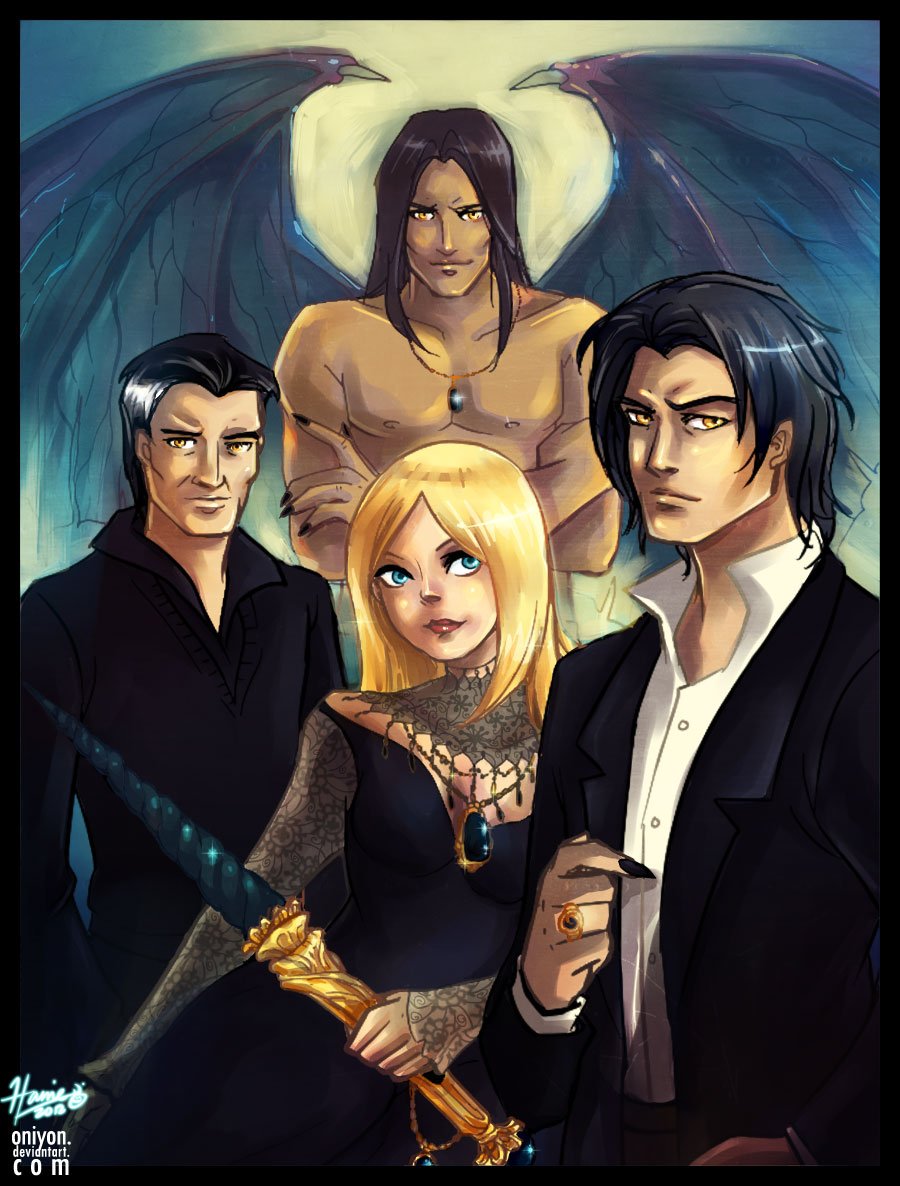
The protagonist, meanwhile, is harassed and raped (age 12) in a psychiatric hospital, due to quench her MarySue-ish magical powers. Her would-be-true-lover (1700 years old) is one of the sexual slaves of the antagonist. Because of his BDSM inclinations he’s known as The Sadist. He’s been waiting to love and serve the protagonist centuries before she was born.
His bro is a sexual slave, too. They are both slaves because their daddy—supposedly almighty Lord of Hell—couldn’t have acknowledged them. And the said Lord of Hell—called Saetan SaDiablo; so subtly indeed—considers the protagonist his spiritual daughter. That “parenthood” doesn’t stop him from being aroused with sucking her blood. Yummy.
And so it goes on. The tortures, the rapes, the pedophile and incestuous vibes, the guys who are going mad with sex-driven fury… And the males who are sexually enslaved appear actually not only in the books about the main pack of our heroes, but in the spin-offs—such as The Invisible Ring—as well. And I have one big problem with a trope like that.
If some fantasy series was centered on female sex-workers enduring humilation and submission and dreaming of revenge, such a series would be considered as a one fetishizing women, probably. And I would agree with it. But then—it does mean that Black Jewels are fetishizing men. If the issues of male sex-working or male slut-shaming are raised in the series, it isn’t a metaphor whose aim is to show women’s problems through reversion. Neither it is the way of making the readers aware that sexual violence can afflict men too. No. You know the reason for depicting sexually enslaved men in this show? Just for the porn. Because it’s so kinky, you know. Pretty down-trodden angry guys. And you know what is the reason for all the rapes and tortures? It’s a plot device serving as a compassion-generator. When your characters need to have a trauma, let’s give them some gang rape or sadistic tortures! Who cares about real results and real victims of violence and PTSD…
Lame Worldbuilding
So, the Great Lord of Hell is called Saetan SaDiablo. His sonnies are called Daemon Sadi (a demon of BDSM, you know) and Lucivar. His evil ex-wife is called Hekatah. His good ex-wife is called Cassandra. And what is the surname of Jaenelle, our protagonist? Angelline, of course. And let’s not forget about Surreal, a badass spy-sex-worker who is an ally of our protagonists.
Repeat after me—this is lush dark fantasy. Lush dark fantasy creating subtle and voluptuous atmosphere. Does it really matter that the main characters’ names sound like in a bad paranormal romance on Wattpad? Does it really matter that only a Soviet tank can equal their subtlety?
And “suggestive” naming is only the tip of the iceberg of Black Jewels’ worldbuilding. Because, except for the magical hierarchy (including virginity-fetish rituals, of course) and the rank of magical jewels, there is no worldbuilding. Except for talking dogs and big obese cats, except for the concept of three plains of reality (Tereille, Kaeleer and Hell), there are no original ideas. There are some lands and some cultures, but we don’t get anything specific or climatic about them. Whether it is the Keep where Saetan resides or the hospital where Jaenelle was imprisoned, or the destroyed land of Zuulaman, we are not given any details. It gets a bit better with spin-offs focused on Shalador, but even in them, the author wastes the potential of her universe. There’s an exiled ethnic group there, there are traditions concerned with dance and music, there is tree-symbolism… But, as usual at Bishop’s, smut talking, trauma fetish and sexy undertones are more important than any promising background.
But the worst thing about the worldbuilding is its randomness. Because you’ll have no clue on what period the setting is based. When a winged warrior fights with a crossbow and then opens a fridge and goes to a cabin shower, know that something bad has happened.
The case of Black Jewels isn’t inconsistency on purpose like in retellings or urban fantasy books, or other ones which blend genres. The case of Black Jewels is “I put fridges, cameras and suits alongside feudal hierarchy, talking dogs and dragons and 50000 years old demons because my priority are SexyBoys and MarySues, not any worldbuilding”. But you can’t have everything. You can’t have a boudoir-like atmosphere and fridges. You can’t have a Regency-like aristocracy compiled with hierarchy matching more some quasi-medieval times. Because if you put it together, it’ll be looking ridiculous.
Stiff Gender Roles
I really wonder what the life of trans or non-binary people looks like in the world of Black Jewels. Does a trans guy can be a witch because of his biological organs?
Is a magically-gifted transwoman not allowed to be a witch? Should she be a Warrior Prince, instead?
Oh, wait. There’s no problem. Because in that world, there are no non-heteronormative people except for a backstage GayTokenFriend and a LesbianTokenFriend. Gender equals biological sex. And it’s even a wider problem than the absence of the whole minorities or the fetishizing of menstruating people. Than highlighting male vs. female dychotomy and making jokes about it in the good old manner of “your old lady…”—most of the books’ humour relies on that, really. No. It’s the problem of the very worldbuilding.
We are told we are in a matriarchal society, but “weaker” witches are sexually assaulted and treated like breeding mares. And please don’t say that it may be the question of class. Did in medieval Europe well-born ladies harass peasant males commonly? I guess they didn’t.
We are told we are in a matriarchal society, but when a male Blood wants to serve a Witch, the Witch can’t refuse him. And in the cases of some characters, such as Jared in The Invisible Ring or Lucivar overall, this need of serving has some toxic bossy understones actually.
We are told we are in a matriarchal society, but (almost) only males are warriors and only women (those with a less potent magical gift) are housekeepers. And there is no true alternative to it.
Because when a guy starts cooking in JewelsVerse, he either screws everything up or wants to Arrange a Romantic Supper. I know that in Paranormal Romance it may look funny, but in the broader context it just consolidates harmful gender stereotypes. *recalls Mortal Instruments and Twilight* Oh, wait, maybe it’s the specificity of the genre.
The Invisible Commonfolk
Gender roles aren’t the only inchangeable ones in the series. The same is with the class system based on the magical aristocracy of the Blood and the rest being the commoners serving the nobs. The hierarchy is almost always hereditary, with exceptions made for the MarySue-ish characters—Saetan is a son of a sex-worker and Queen Cassidy (the protagonist of Shalador’s Lady) is from an ordinary family.
Usually, the villains are blood-purity-obsessed classists and they hold the low-born ones in contempt while the protagonists do care about them. Does it mean that the books are pro-commonfolk, though? It doesn’t. Commonfolk is represented in them as long as it is useful—useful to show how friendly and caring Jaenelle/Saetan/Cassidy/whoever else from the Goodies is. Also, the hierarchy is never directly questioned and the problem of feudal violence (including economical and sexual abuse of commoners and weaker witches) comes down to “bad people supporting Evil Dorothea SaDiablo and good traditional order”. *toxic vibes of Darkover and Six Duchies*
But, again—it could be the question of the genre. Mortal Instruments with their “Jace-demon-hunter-aristocrat” is equally classist, after all.
Mary Sue, Mary Sue!
Oh, this series is shamelessly open about MarySue-ism. So open that I have never encountered such a shamelessness. Maybe except for the “works” of Mr. Paolini.
Almost every protagonist has some powers unusual for their age/sex/class. Saetan and Daemon are Black Widows, performing magic of dreams and poisons, which is usually associated with women. If it isn’t enough, they wear the strongest jewels possible, the Black ones. Lucivar is a persecuted half-blood wearing a Black-Grey jewel who’ll grow into the leader of the Eyriens, his mother’s reluctant people. Surreal is a badass spy-sex-worker with a Tragic Past (oh wait, almost every protagonist has a one) and mysterious heritage of the Children of the Forest Dea al Mon, wearing a Grey jewel. Only two levels lower than the very High Lord of Hell, you know.
And Jaenelle… Oh, Jaenelle is the essence. Even when she was seven, her eyes would glimpse with the wisdom of entire ages. When she was a kid, she’d already collected jewels darker and stronger than any known ones. When she was twelve, she survived a gang rape and appeared to her would-be-TrueLover Daemon as a clawed woman with hooves, with lion’s mane and with a corn on her head. No, she isn’t some crypto-tiger-unicorn-horse. She is the embodied dream of the whole generations of the Blood, the Chosen One destined to restore Old Good Order and to defeat Evul!Dorothea SaDiablo. And now I’m asking you—how, on Earth, could we treat such a character seriously? How could we treat any of the protagonists seriously?
So… Are There any Good Things?
They are, after all.
If not all the bossy/incestuous/simply silly/#alwayssexual vibes, reading about the family life of Saetan and his sons would be quite nice, a fresh perspective of dailyness in a generic Paranormal Fantasy. If not all the rule of “Saetan and his lot are always right/justified” reading about Lucivar defeating his racists&classists political adversaries would be a good thing to read. Also, the metaphor of racism overall isn’t that bad in the series. But all the other things are in the kind of Draco in Leather Pants riding a pink unicorn.
Read on your own responsibility, I warn you.

 Left Hand of Fiction