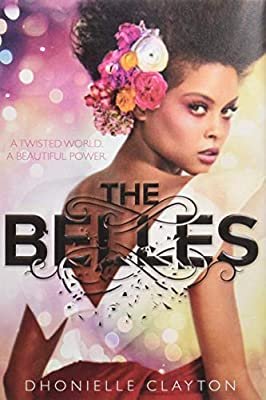
Imagine there is an island kingdom where the people are born grey-skinned, red-eyed and overall ugly. And only the Belles, a group of girls gifted with magic, can make them beautiful and colourful. But it has a price. A price of pain and of even worse things of which the younger generation of Belles isn’t aware.
Welcome to the Kingdom of Orleáns.
I could praise Dhonielle Clayton for an original setting based on New Orleans and French royal court. I could praise her for choosing French names deliberately. I could praise her for the world which turns from lush and georgeous to terryfying and cruel. I could praise her for writing her characters out of any racial and sexual orientation stereotypes. I could praise her for bitter metaphor of body image, beauty surgery and the look standards which are still required from women.
But I think that in her book, yet another metaphor is hidden.
To my mind, The Belles are the homage to placées of New Orleans and other regions and cities of French and Spanish colonies. Assuming that Clayton is well aware of the racial history of New Orleans—and from her interview I think she is—it is quite possible.
You may ask, who a placée was? Does it have anything to do with the beauty-disposing Belles?
Well, at first you need to know what was the institution of plaçage. It was an official system, popular especially in New Orleans, in which ante-bellum white rich guys took women of colour for their concubines and often had children with them, and those children—or rather, sons—were sometimes bestowed with education and freedom. The daughters usually had to follow their mothers’ path and were schooled for the next generation of misstresses.
Nowadays, it’s hard to judge such a social institution. Was it better than prostitution? Were placées safer than slaves on plantation—because they had to have only one lover and they were protected by their sponsors? It isn’t easy to answer such questions and Dhonielle Clayton doesn’t offer easy answers, either. Neither she does her metaphor obvious and straightforward. She does something else.
She writes her Belles in a lush and mysterious way, but out of any crude patriarchal sexualisation with which the placées were described even in complex and acclaimed books like Absalom, Absalom! She writes them as companions and sisters, enclosing them in the female world. She hides them from the world and makes them learn the secrets of beauty from their mothers and female mentors. Untouchable to men, they are chosen by the aristocratic houses to reshape and recolour human bodies as they are presented to the world after the years of childish and adolescent seclusion. But their life depends on the mighty ones’ whim, and the fate of turned-down Belles is terryfying.
To my mind, it is all the metaphor of placées existence. Secluded and guarded, they were chosen by their well-born sponsors and casted-off when they grew too old. Of course. The world of the Belles contains all those aspects of their existence, including desolation and eventual rejection. But it also omits sexual context on purpose, and transforms the deadly and beautiful girls into the symbol of the true Orléans.
Under the glamour and lushness, cruelty is hidden. Just as it was hidden in the racial relations in the real New Orleans, and not only there.

 Left Hand of Fiction