There is something exquisitely sincere about the books of Frances Hardinge set in the England’s past. Exquisitely sincere and shameless.
Because Hardinge doesn’t conceal she writes from the progressive perspective and tells the past from the point of impassable classism, bigotry and sexism, and all this wrapped in unobvious fantasy elements.

Each of her “past” books seems to be focused on a different aspect of it, but the reader is reminded of some themes in all the three of them, the themes like change, classism, dysfunctional family and social “order”.
In Cuckoo Song, we watch the poor ones from an outer perspective, as the main character finds shelter in the company of a neglected feminist living among workers. It doesn’t mean, however, that the hopelessness of their existence isn’t caught; it’s caught into the dirty streets, into the worn clothes of children, into sparse food. It’s caught into the helplessness of servants who couldn’t get a proper job because of their unfair employer’s references, and into the anger of men who returned from WWI and got nothing from their country. And all those motifs and descriptions sound even more true being on the verge of the story, not in the centre of it. In Cuckoo Song, the poverty isn’t a nice component of a picaresque novel or a pretext to some inspirational porn. It’s an emanation of all-surrounding classism, of the order where the rich ones are the decent ones to such an extent that the morality and symbolic power become the one. The workers are indecent. The suffragists are indecent. Jazz is improper. And it’s funny how nothing has changed, after a fashion. We like jazz but we consider dying hair pink or blue improper. We take women’s work and voting for something obvious but we call the feminists femi-nazis.
The main theme, however, is family, the family which isn’t ideal merely because of being based on indissoluble heterosexual marriage. The family which coupes with fear and depression and whose members don’t know how to help their children. The family which excludes Triss, the main-and-not-the-main-character, from the social life under the pretext of caring about her safety and mental health. The family which has grown toxic not out of some unspeakable evil. It has grown toxic under the expectations of the society and under the burden of WWI’s tragedy.
It’s also a book about fear. The fear of the Other One—personalized in the Besiders and their mysterious community—and the fear about the world which changes quickly in the questions of class, politics and religion. Guess what on the which side Hardinge places her most badass-y characters.
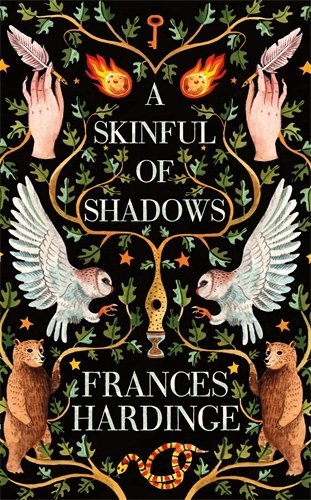
A Skinful of Shadows, her book set in the Civil War England, approaches the classism and the concept of a toxic family from another side. It also makes the reader aware about the suffering of the animals—introducing two main characters, a girl called Makepeace and a tormented dead bear whose soul coexists with her mind in her body.
In this book, an aristocratic family of the Felmottes becomes the symbol of feudal greed and ruthlessness. The Felmottes not only do the usual aristocratic things like instigating the commoners against each other, mistreating servants and siring bastards carelessly. They also practice a kind of necromancy, and they use their illegitimate children as provisional containers for their ancestors’ souls. Makepeace, as one of those children, decide to rather escape into the havoc of the Civil War and save her half-brother than to endure it. She meets the puritans destroying the churches on the one hand and the king living in luxuries among dying and plagued people on the other one.
It doesn’t mean, however, than in A Skinful of Shadows, the aristocrats are villains and the commoners are all good. It doesn’t mean that the king is a tyrant and the puritans are noble revolutionaries. Neither does it mean that the king is a Poor Noble Guy warring with Insolent Scum.
The king is arrogant and doesn’t see the people’s needs and their suffering. The puritans, on the other hand, don’t care about any kind of tolerance, neither religious nor the social one; living with her Puritean uncle as a small girl, Makepeace is outcasted as an illegitimate child. She isn’t treated like a family member, actually. Those Good Ol’ Days indeed… And that Christian mercy.
Hardinge reminds us of something of which we don’t like being reminded. She reminds us of not only the fact of illegitimate children’s existence which was erased by the middle class’ understanding of the social history; the understanding which assumed that the marriage with a pack of biological kids was the only form of family. She also reminds us of the treating of such children; somehow, the pro-lifeism would always end when a child was illegitimate or—although this theme isn’t raised in her books—of colour, or both.
But the most important theme of A Skinful of Shadows may be the same as in Cuckoo Song—the change, the shifting time. The time when the commoners oppose the king so commonly and so openly the first time. On the one hand, Hardinge emphasizes the power of it. On the other one, she doesn’t describe it in simple categories—reactionary aristocrats and progressive ordinary people. She never forgets that the rebelling puritans were progressive in their demands of representation but very intolerant towards those who differed from them on the religion’s ground.
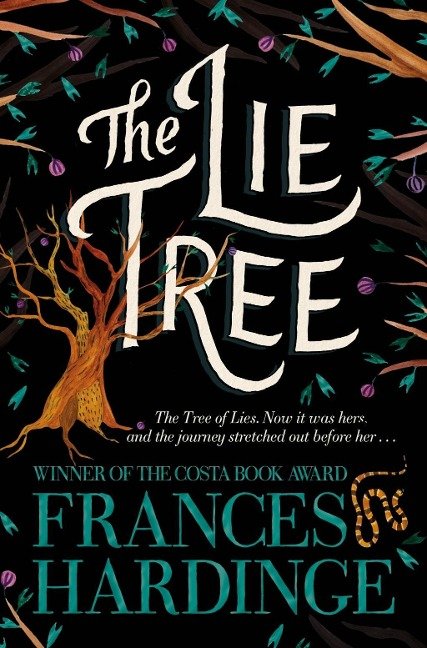
The Lie Tree, her book set against the 1870’s England, focuses more on the sexism, science and bigotry than on the broader political perspective. And unlike A Skinful of Shadows, it doesn’t do the commonfolk representation through introducing the main “low-born” character. Instead, it shows a daughter of a respected minister, and a lot of disturbing people and social phenomenons around her.
The Lie Tree is even more complicated than the previous past books of Hardinge, full of contradiction and paradox of the Victorian society. The father of Faith the main character is sexist but he relies on his daughter’s intellect. He is a Christian shattered with the revelations of the evolution theory. The main villain is a female scientist hidden behind the back of her second husband who runs the local excavations only for the sake of her pleasure. A supposedly benevolent doctor comes out to be a vengeful misogynist. The woman running the post station is accused of an affair with a married man but she is a closeted lesbian actually. The community of the island seems well-mannered and welcoming at first to turn excluding and ruthless. The death photographs depict the dead ones as if they were alive.
It’s a book very open about the impassibility of some nineteenth-century barriers. It’s a book about condemning the females-(scientists) and keeping them silent, out of sight and out of influence. It shows why speaking of stupid women who’ve been never as innovative as men is such a nonsense—the women weren’t given their chance, being prevented from education and discouraged from it. After a fashion, they still are.
The silence, a kind of mafia-like omerta stretches out over other questions as well and entwins everybody. Illegitimate children are buried out of sacred ground, invisible, forgotten. Faith’s mother pretends that her son is right-handed like “other” children. The death of Faith’s father is rumoured but never openly named. The servant who started the rumours keeps silent—and vengeful as she is, she had her reasons to do this way and not another. The employers pretend being in good relations with the servants and vice versa. Everybody pretends being kind and rightous. But under the cover, in silence, all the vileness grand and petty is hidden.
If you complain on PC and cancel culture, you should remember that those trends are nothing in comparison to all the nineteenth century censorship and exclusion—when nobody talked to you because of the supposed suicide of your husband and when piano’s legs where covered because they were to evoke sexual associations. But, of course, we tend to perceive the past as the time of freedom of speech and action. Well, it depended who spoke and about what and what one did. Behind the illusion of liberal past, there are whole silenced and diminished groups, and the consequences much worse than being called a racist or sexist in the social media. And it’s even more terryfying because the vileness in The Lie Tree isn’t something terryfic; it isn’t about direct violence, about genocides, slavery and pogroms. It’s about the petty things done by supposedly decent people— which show the best why decency is more about the power of some groups than about being a kind-hearted person. And Hardinge—unlike so many of those who write about the past —says it openly. She shows that so-often romantized times—like interwar period—weren’t friendly for the commoners, or for anybody who stood out.
And the best thing about her is that she doesn’t yell it. She whispers it. She doesn’t show her female or low-born characters only or mostly as victims. She shows them as human struggling (not always in a fair way) for humanism in the world which is often unhuman—both on the paranormal and on the mundane level.

 Left Hand of Fiction