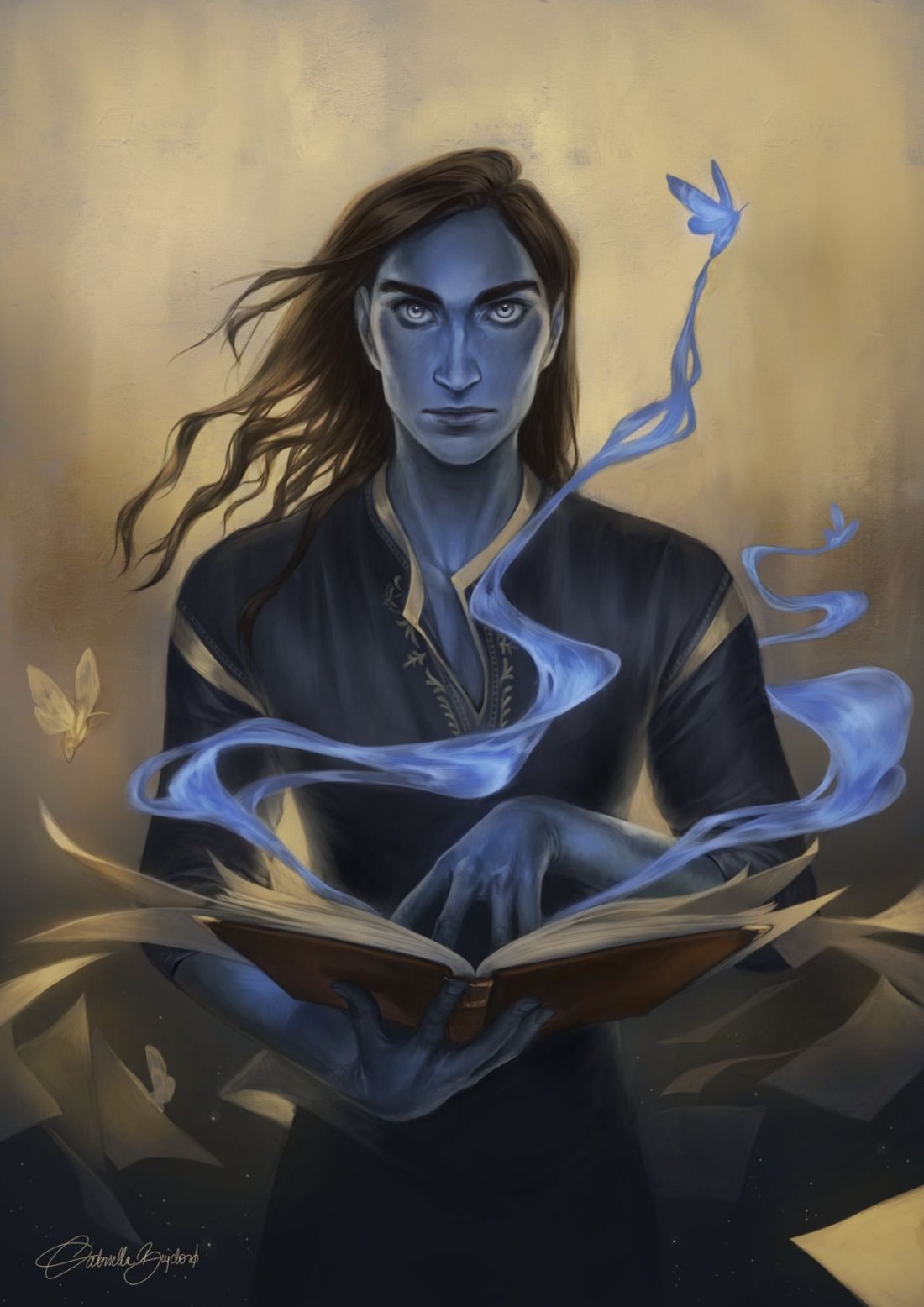
I don’t like all the “Why you must read the book X/Y/Z”. Still, I think that the story of Lazlo Strange the librarian and Sarai the Muse of Nightmares trapped in the citadel on the sky over the city of Weep deserves such a “must”.
Because the books about them are just enchanting and wise, which is always a treasure in literature, not only in the fantasy one.
Being used to stilted and plain PoVs, I was surprised at what Laini Taylor could do with this way of writing. The voices of her characters are rich and imaginative, introducing the readers to great crimes and great wonders alike. The descriptions are telling and lush, and the locations easy to depict. There is something really magical and magically real about the world she created. Her setting is so similar and so alien at once—the City of Weep may be Middle-Eastern, Mesoamerican, India, African; it depends which inspiration seems the most vital to you. At the beginning, you might perceive it as yet another Exotic City with great mysteries and queer atractions and customs. You might perceive it like that because you’ve been taught—we’ve all been taught—it.
And then, the very book makes something incredible. It makes us perceive the city of Weep as the homeland, the neighbourhood. It shifts the notion of “normality” from a Western Culture-based setting to an “exotic” one. The City of Weep is a norm here, and the brown-skinned people, the ordinary ones. It isn’t the case of “you can always imagine that they are just tanned” or “look, I did representation, I’m sooo tolerant that I’ve thrown one non-white and ten white characters!!!”. Whether the citizens of Weep resemble some particular race or not, they aren’t white and they aren’t tokens, either. Make up with it, dear racists.
The inhabitants of the city—those from beyond like Sarai and those from below like her father, Eril-Fane—are the most traumatized characters as well. They cope with the terrible powers, being the children of blue-skinned “gods” from the citadel who were kidnapping and raping the locals for decades. As the people of Weep, they cope with PTSD being the result of abuse—sexual, psychological, physical. Men and women alike, which is, I would say, very wise of Taylor. They cope with their culture being destroyed and their identity erased. And thus, it seems to me, the story of Weep becomes on some level the story and the metaphor of colonialism. The powerful ones of literally god-like status who came from far away and who abuse the locals? We’ve seen it too often in our own history.
Another aspect of the story worth of praising is the notion of love. Love between Lazlo and Sarai, between Eril-Fane and his wife, love between two men and two women, love between siblings and friends, between a mother and her son. The love stories aren’t toxic. They are developing slowly and they are based not only on sexual fascination, but on the friendship as well. Sometimes, they come up unexpectedly, as in the case of an alchemist Thyon Nero who realizes that instead of being trapped into an arranged marriage, he could love another boy. The difficult relations —SPOILERS like that of Eril-Fane and Sarai, who was a child of rape on him, actually SPOILERS—are explained. The toxic ones—like that of Eril-Fane and Isagol, Sarai’s mother—aren’t justified and turned into some kinky fantasy. It’s just wise. And, as I’ve said, I didn’t expect such a wisedom from fantasy YA books.
The duology is good not only as a work of fiction, but as a fantasy, too. The world—or rather, the worlds—it describes are vivid and imaginable, rich with colours and scents. Some concepts are more SF than fantasy, but they are given in such a form that one might read it more like a myth or a legend. There is a lot of alchemy, there are people with two hearts and those who are changed with a magical metal. There are ships roaming the stars, and enchanting dreams more vivid than the very life. There are ghosts trapped among the alive ones. There are names erased with the sheer magic. In the core of it, however, the brutality of selfish blue-skinned “gods” remains and it erases any impression, any illusion of entering the universe somehow better from the one of our own. And overthrowing such illusions is a thing I appreciate.

 Left Hand of Fiction