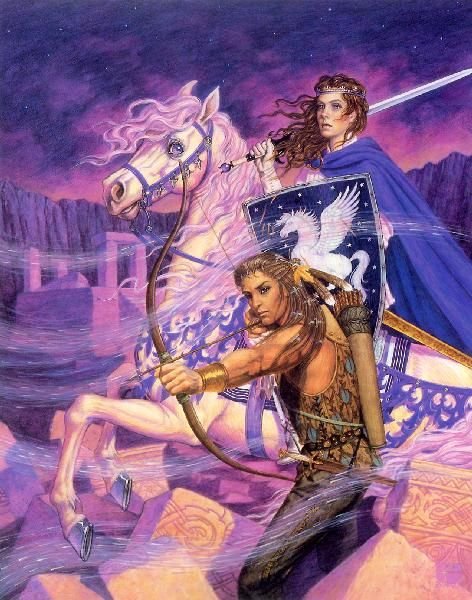
This time I’d like to introduce you to the series which isn’t the best written one, the most original one, and yet it is one of my beloved fantasy series. And why? Why is it never as irritating as some books of Guy Gavriel Kay or Robin Hobb, the writers actually more skilled than Lackey is? Maybe because the books of Valdemar are just friendly, with no controversial or toxic content. Or rather — whenever there is something toxic or evil, it is condemned. It’s quite a simple vision, but a safe one, too. And Mercedes Lackey never pretends it is otherwise. She doesn’t pretend she writes epic and deep stories beyond their genre. She’s sincere, and so her books. And thus, they are more interesting than so many works pretending to be profound and unusual. One is entering the world of white-clad Heralds and their horse-shaped Companions, and feels at home.
An All-Embracing Realm
Valdemar series is actually a Young Adult series, and it’s quite obvious even when you look at the main characters. Most of them — Talia, Darian, Vanyel, Elspeth — are teens or young people, or at least, the story arc begins when they are teenagers. However, I would say that there is a difference between the YA of Valdemar and the YA of some newer authors, like Rebecca Ross, Mary Pearson or Laura Sebastian. In comparison to them, Lackey is sincere, not pretending anything. Her LGBT characters or characters of colour aren’t tokens but living human beings, and her royals aren’t egocentric princesses escaping from their royal duties (A Kiss of Deception so much). I mean, I’m not saying that the pop YA books were better once, in the mythical Olden Days. I mean that the series of Valdemar is better than many popular and shorter series. It takes the main role of YA — lifting the teens’ spirits — seriously. It shows the young people seeking their place in life and facing various prejudices — homophobia, classism, racism, ableism. It shows not the power of True Lav in the way of Twilight or Hush. Above all, it shows the power of friendship which helps in overcoming prejudices and hardships, the friendship all-embracing and accepting, the friendship as important as love. I think it is an important point. In YA, the friends are often in shadow, making place for the Great/Tragic/Forbidden Love. To show another side of love, not only that amorous one, to show the bonds of friendship, of sisterhood, is something both important and refreshing. In Valdemar series, friends are friends, not tokens or pretexts. And they give hope. They give hope of finding love and acceptance in the outer world, the love which sometimes you cannot find within your own family. You have no clue what it meant to me when I picked up this series the first time, how heart-warming it was, the very notion of hope, the very thought that if the characters found friend, I could find them, too. And it gave me another hope — that one day, there will be a place where I would be accepted with my views.
The theme of not-suiting into your family is the important question in the series as well. The difference between conservative kin and outstanding children is visible especially in The Last Herald-Mage trilogy and in The Owl Mage trilogy. The second trilogy gives us a gentler example of a young healer Keisha bored with the traditional life of her village. However, I think that the story of hers and her siblings is important, as it shows several things. It shows that you don’t need to agree on everything with your family. It shows that the differences are normal, and that the kids doesn’t inherit views and lifestyles from their parents. And it’s a good metaphor of social changes in the Western world (and in USA especially) altogether. The Native Americans-like Hawk Brothers coming to Errold’s Grove, colourful and casual, may evoke the associations with the hippie culture, and the changes in personal life which it stirred. Keisha conceals from her parents she is living in an informal relationship. On the other hand, her mother begins engaging her brothers into domestic tasks. All these things might be read as the parallels of the sexual revolution and — several decades later — the family roles’ changing, at last. And, to my mind, showing the boys cooking and washing is a rare sight in fantasy, and an important one, assuming the discussion of the gender roles. Because without the equal share of domestic duties, we would never achieve any true emancipation. There is no sense in writing about mighty priestesses in Avalon and princesses-warriors when the ordinary women in your fantasy land would still stick to Kinder, Küche, Kirche. And there is something in Lackey’s books grasping the dailyness naturally and easily, even if the main plot of a book is rather generic in the meaning of the genre, adventorous and magical.
In the Last Herald-Mage, the relations of the main hero, young Vanyel Ashkevron, and his parents, are much more difficult. For Vanyel turns out to be a gay, and his conservative father doesn’t accept it. Oh, wait, doesn’t accept is actually an euphemism. And it is so believable, so sadly true, that I find the trilogy one of the best set of Lackey’s books. Its portrayal of homosexual people is against all the prejudices and all the superstitions. SPOILERS Vanyel is a pretty guy, but he grows into a conscientous and serious man, with few time for his personal life, marked for ever by the tragic loss of Tylendel, his first love. For years, he lives in chastity to meet a young cheerful bard who strangely reminds him of his late beloved one. SPOILERS
You may think that it meets the lots of cliches typical for a story of a heterosexual romance. But I think that Lackey made the personal story of Vanyel in such a way on purpose, to overcome all these nasty superstitions about promiscous gays caring only about sex. It’s a play with a reader showing that the story of love is universal, no matter what the orientation of the lovers is. And to show such an universality isn’t an easy thing. Usually, and there is a reason for it, we describe non-heteronormative relations in the categories of discrimination, or of something secret, or unusual. Lackey shows the homophobia — sometimes in its most terrible forms — but doesn’t forget that love is love, a thing to be related and told beyond gender and orientation.
Another question is the portrayal of supposedly negative characters in the trilogy. Because here the homophobic people don’t remain homophobic forever. Lord Ashkevron is an interesting example of that. He begins as a man forcing his son to exhausting sword-fights and calling him a catamite when the secret of Vanyel and Tylendel is revealed. In the second book, he seems to tolerate his son as a Herald-Mage, but he is still afraid that Vanyel would harass young boys. The conversation between them, touching the harmful stereotype of “Gays are paedophiles!1!1” is very telling. Vanyel only explains to his father that he prefers men just as he prefers women. And in the third book, when Vanyel introduces his beloved bard Steffen to his parents, Lord Ashkevron admitts he’s fine with his son’s choices, because Steffen is “a good lad”.
It’s typical for for the series, to show the characters who change, who could be sorry for their cruel deeds and words, who come to accept an outstanding person even if they don’t do it in the supposed progressive way. It’s just human. The same is with Talia, the character brought up among puritanical Mormon-like group, and the main hero of the first Valdemar trilogy. She accepts Keren, an older lesbian Herald, because Keren is just her friend. And because — surprisingly — she was well accustomed to the women making the same-sex bounds in the male-dominated world of poligyny. All that may seem exotic for some readers, but the puritanical experience of Talia is actually well-known and typical for many regions in USA. Like with the Hawk Brothers, it’s a parallel. And so, the series is embracing on many levels, describing both the people with a very conservative background, and the people seeking escape from the so-called “tradition”.
The Plot And The Worldbuilding
Although the kingdom of Valdemar resembles quite a stereotypical Medieval state from the Western Europe, the places around it aren’t so cliched, and the very Valdemar is something beyond your typical quasi-Britain. Some names and customs, of course, resemble Celtic-England setting, like the feast of Summer Solstice, the names of Elspeth or Randale, not to mention some spelling rules. However, Lackey has some nice-sounding names of her own, like Vanyel or Selenay. And many Valdemaran customs, including the Heralds’ traditions, the schooling of Bards and Healers, aren’t taken entirely from the European universities, Celtic bards and French musketeers. There is some original touch in them, and so with the countries and cultures surrounding Valdemar. Karse is a theocracy with a solar god, the people resembling the Middle Eastern ones from look, and with some names evoking associations with Germany. Rethwellan is known for its mages, and for the kings with incredibly long names. The Empire on the east resembles Ancient Rome. Both the Shina’i’n on their steppes and the fair-haired Hawk Brothers from Pelagir Forest are quite similar to — generally — the Native Americans. This similarity, however, is quite vague and based on the most recognizable associations — the “telling” names like Darkwind, and on the skin colour. The true is that the Hawk Brothers and the Shina’i’n have many traditions invented by Lackey on her own, like the sworn maidens of the Goddess, the modifying of weather in the forest settlements or the ekele buildings. What is more, the both groups are usually blue-eyed.
One may think that actually, Lackey doesn’t break the chain of portraying the people of colour in the stereotypical way. Both Hawk Brothers and the Shina’i’n — and sometimes even the Karsite — are described as the people exotic and remote from the Valdemaran perspective. However, all these groups get their PoVs and valid opinions through the various books (and books which are focused almost entirely on them), and their characters aren’t defined by their “colourness”. And Hawk Brothers and the Shina’i’n are usually portrayed as allies. Karse, at the beginning, is the foe, but the Mage Storms trilogy will redefine everything we know about this country. Not to mention that Karsite Alberich is one of the Heralds and the most likeable characters from the very beginning of Valdemar series, and Darkwind SPOILER would enter the Valdemaran royal family as the Princess Elspeth’s True Love SPOILER.
And, actually, I’m hoping that the blue eyes of the local Native Americans and the dark skin of the quasi-German theocratists are the signs of playing with the convention, not of treating the PoC carelessly. It’s actually quite close to the awareness that the fantasy genre doesn’t need to evoke our world. People of colour don’t need to be exotic and the whites “normal” for the reader. One could be copper-skinned and blue-eyed at once. It’s all relative. It’s fantasy.
Another advantage of Lackey’s worldbuilding is its vividness. The intrigues in the series are quite pretext and by no means as magnificent as, let’s say, the ASoIaF plot, but the world of Valdemar is, somehow, more imaginable. One could easily depict the warm forests and the cosy ekeles of the Hawk Brothers, the old grey buildings of Heralds’ Collegium, the village cottages of Errold’s Grove, the wonders of the winter fair in the capital city of Haven, the chaotic castle of the Ashkevron family. It’s all thanks to Lackey’s style. Her writing isn’t masterful — she always uses PoVs — and yet the voices of her characters are much more varied and not stiff at all in comparison to the quite blank style of George R. R. Martin.
In comparison to the modern YA, however, the plot of her series is quite pretextual and fragmentary. The main events take place in the times of Selenay, Elspeth’s mother, and are concerned with the intrigues threatening Valdemar, and with the worldwide changes caused by the rebirth of ancient magic. The story of Vanyel, on the other hand, takes place over four hundred years earlier, and is focused more on Vanyel’s magical confrontations than on any serious and consistent political intrigue. There are also the stories of local First Age, of foundation of the Collegium (Potter vibes so much), and of Tarma and Kethry, the two friends and female warriors. Still, it seems to me that “Selenay times” are the most important ones for Lackey, and it is so visible. The threats and intrigues are quite simple; it’s clear that the well-known characters are more important than the events. There is some pattern, of course — the return of ancient wild magic — but it is a vague one.
In the question of plot, the first Valdemaran trilogy, telling the story of Talia, is maybe the weakest one. It would be quite good as the three separate novels — one of the “school years”, the second one of travelling through Valdemar, and the last one of international political intrigue — but Lackey made these three novels inseparable, incomprehensible without one another. There are some other flaws of the trilogy, as well. The antagonist is so over-drawn that he must be a creepy-sadist-rapist bastard, of course. Talia is shy and plain, but then she gains numerous friends and wooers, of course. The main love story is stilted (SPOILERS I would see Talia rather with her buddy Kris than with Dirk, her great and unexpected True Love SPOILERS). Elspeth is a little brat, and thus could be spanked. Nope, Lackey. No matter how wretched a kid is, one doesn’t deserve beating. A patient and effective tutor can make a child complaisant without violence. It’s especially sad assuming that Lackey’s books are usually progressive. But here, conservative vibes attack. There are also some drastic and controversial questions touched vaguely, like rape and paedophilia. And this is not the way — on the very backstage, without the victim’s voice — of describing such things.
The advantage of Lackey’s writing is its improvement, however. Later in the series, there would be no justyfying violence towards children, the intrigues would be more believable (but still usually My-Beloved-Characters-centered), and the terryfying and drastic questions described properly. I mean, they will be described from the victims’ perspective (The Winds of Fate), as something which is terrible and harmful, and yet to overcome. The long-terms of rape or harassment will be shown, and the perpetrators described with no justyfying. Such a way might be simple. But, on the other hand, I think it’s important to give the teens the clear image of sexual violence, and any other violence. It’s bad and it will be always bad.
The Characters, or the Pre-Revolution of Women and Minorities
The interesting thing about Valdemar series is that started in the late ʼ80s as it was, it focuses on themes and characters which became important in the fantasy genre only later. Female protagonist? Check! Non-heteronormative characters as the main heroes or the foreground characters? Check! Girls with power? Check! People of colour? Check! Social-economic problems? Check!
And the best thing about Valdemar is that the characters like that are never tokens. They are much more than their gender, orientation or skin colour. They have their personality and interests, their goals and friendships. I’ve examined it on the example of Vanyel and Hawk Brothers, but there are two things I appreciate epecially about Lackey’s writing.
At first, women characters. They differ in interests, goals and looks. They are just universal protagonists and foreground characters. Usually, there is some love story in their plot, but it is not introduced in the way of paranormal romances and so on. The True-Lovers are neither the sense of their life and the obvious Future Husbands, nor the abusive freeks. And there are friends, friends beyond age and nationality — it’s a difference after all these books where the girls friends are usually just another lassies at the same age.
And, above all, there are no stereotypes and no fetishes. I was just happy to read about women who are excellent fighters, about women completing dangerous missions, about women who aren’t judged by their sexual life. It is a safe space from the evolutionary biology prejudices and social stereotypes. But there is another side, too, the side of the women gaining admiration and respect through their compassion (Talia) or healing skills (Keisha). And yet, there are no cliched Caring Bears. They show how important the emotional intelligence is, and how connected it is with the other kinds of intelligence.
At second, the commonfolk. The commonfolk isn’t a decoration here, the decoration of happy peasants or dangerous urchins and so on. Many foreground characters (like Keisha, Dirk or Skif) or even the protagonists (like Talia or Darian, or Karal) are born into ordinary families. The families of farmers, hunters, innkeepers, crafters. Sometimes, they are orphans brought up on the street or working under terrible conditions. And guess what? They don’t came out to be the lost children of some royals or mages.
The important thing is that Lackey shows two sides of the common life in a quasi-medieval world — the poverty and the dailyness as well. That is something you wouldn’t find in, let’s say, most YA, or in The Farseer Trilogy. The sufferings of Mags from the Foundation series are not a fetish. It’s a sad description of the children’s labour. The same is with Skif. His street background isn’t merely a reason for his knife and thievish skills. It’s another story.
The series has also an unusual approach towards dailyness. Here, not only the intrigues and adventures are important. Dying clothes is important. Learning healing is important. Meeting with friends is important. The descriptions of daily events and the secrets of particular crafts are vivid and convincing, and make the characters only more believable.
The Best Possible World? Nope.
However, there is one big flaw in the series approach towards the ordinary people. This flaw is quite common in fantasy, and couldn’t be compared to, let’s say, the classism of Darkover series.
The problem is that Lackey sees the social problems not in the system, but in the individual scale. It’s a simple world where the way of governing is good if the Queen/King is good. It’s a world where occasional charity and finding a house for the children labourers resolves the problem of poverty and abuse. It’s a world where Vanyel can decide on his own about the shape of Valdemaran borders because he is one of the Good Ones.
There are, of course, some quite democratic communities like the Hawk Brothers, but they don’t change the overall image of Feudalism Not So Bad.
However, I’m still hoping that such a vision isn’t the question of Lackey carelessness or insensibility. I think that in the series, there are thing much more important than the social naïvety.
The youthful idealism.
The belief that your birth and orign doesn’t determine your fate.
The simple values of friendship, help and goodness beyond any politics and worldview.
The Companions, of course!

 Left Hand of Fiction