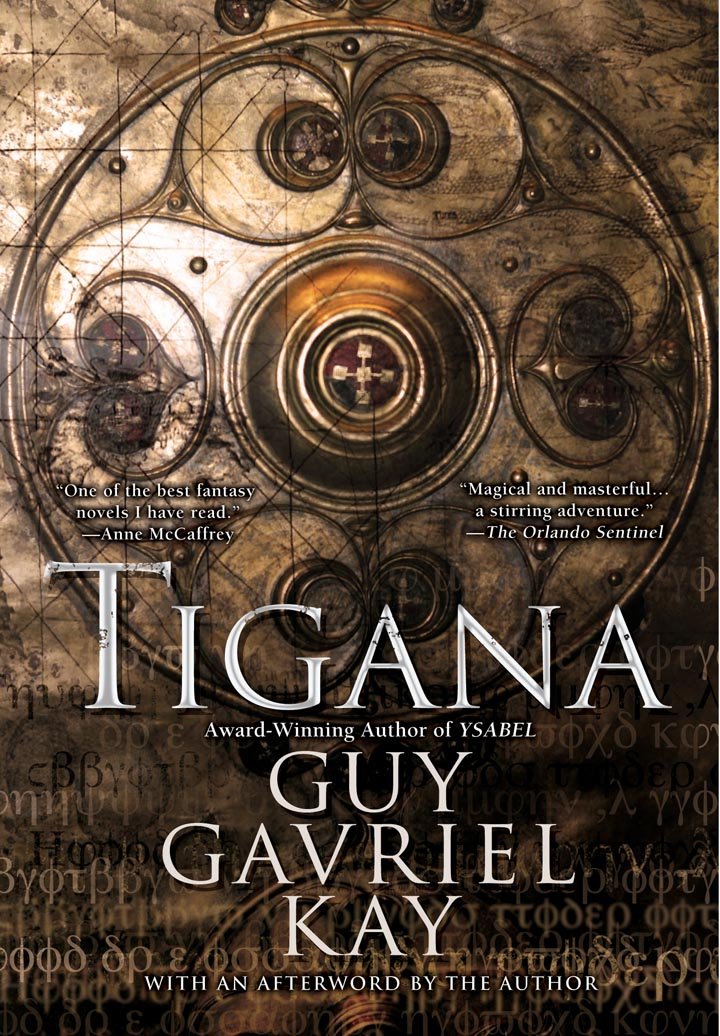
The Fionavar Tapestry, irritating as it was, didn’t move me deeply. Tigana was a different case. Sometimes I think I really like this book. Sometimes I think I hate it. Why? The setting, despite of several flaws, is very climatic. Dianora is a complex character, and so Catriana. Elessar Alessan… He is interesting even if author instill us that he is so. Most characters are from the commonfolk.
Then, what is wrong? Let’s see… Stereotypical homosexuals on the backstage, stereotypical Sensous Woman trope, awkward sex again, some kind of the nationalism useless in a feudal society, a mafia-like noble family, too much pathos, justifying the Good Ones because they are the Good Ones, stereotyped Tyrants and Persecutions, and a king who is a Good Guy because he overthrew matriarchy.
Maybe a summary SPOILERS will give us a preview.
Not even twenty-years-old Devin (which is so Italian name indeed) is such a brilliant singer that he owes some incomes of their music group as a partner. He is also constantly wooing Catriana, a new singer and a fisherman’s daughter, who doesn’t care about him. She is one of the tree new members of the group. They are in Astibar, in the city whose duke, Sandre, died recently. The region — and the eastern part of the Peninsula of the Palm — is under the rules of Evil and Cruel Invader Alberico. The western part is Brandin’s, a sorcerous king from Ygrath, a man who erased the name of Tigana land, because his son had been killed there.
Devin and Catriana stumbles upon on a strange conversation in the duke’s palace. They have random and pointless sex in a wardrobe, as it won’t change a lot in their already ambivalent relation. Then Catriana gets angry, and Devin — who is supposedly So Intelligent — doesn’t understand, why. Alessan, one of the new musicians, scolds him for that and he proposes Devin to join him. He explains that he is the Lost Prince (Aragorn sends approval) of Tigana and he is going to fight the whole Peninsula from the invaders. Devin joins him and his friend Baerd, and Catriana. He learns that he is from Special Tigana, too. He cries when Catriana is singing an old Tiganan lullaby, which reminds him of his mother. Assuming their encounter in the wardrobe, it’s… Creepy.
Then it is revealed that Sandre didn’t die. He is plotting against Alberico with his sons and two noblemen. The whole thing is described in the way which reminds not of, let’s say, the Medici or the Sforza families, but of Vito Corleone and his precious children. Anyway, one of Sandre’s son is a gay. So he is a pervert with Obscene Accessories and he likes Young Boys. Remember, people! Homosexual men are paedophiles and want only sex, not some love relationship. The lesbians… Oh, wait, we can accept lesbians if they are dancers in the very faaar background. Anyway, Evil! Alberico kills everybody except for Sandre, and Sandre escapes, and he joins our precious fellowship team. And then… Well, I let myself to point out the merriest or the most controversial fragments.
On their road, our heroes encounter a sorcerer, Erlein di Senzio, who might be useful for their case (Erlein is another sooo much Italian name; really, it reminds me more of Erlend from Kristin Lavransdatter than of anybody else). Alessan forces Erlein to serve him, because the princes of Tigana are the descendants of the god Adaon, and they are able to control mages. Hidden racism (our hero is Better One because he is a descendant of a god) so much. But what is more important, Erlein is portrayed as a selfish and impolite character, and then, a reader may feel that Alessan is justified. No, he isn’t. And I don’t care that binding Erlein wasn’t pleasant to him, and that he played a Senzian song for the sorcerer, and we are repeated how Moving and Touching it was. No. I don’t buy it.
Meanwhile, we meet Dianora, the Baerd’s sister and the beloved misstress of Brandin in his haremshaisan. Dianora is apparently a Woman with Past. At first, she fell in love with her brother soon after the Tigana’s conquest. Then, when he left, she soon left their family region, too, and she became a prostitute in a mountain inn. OK, I’m not going to judge the incest plot (which is a bit pointless, anyway, because there was nothing incestous in the relations of these two before Tigana’s fall). But I’m angry again with the trope of a waitress-prostitute. The whole thing is portrayed as there is nothing problematic with the sex for money, as “such women need to exist” and so on. Maybe my imagination is too rich, but it is not difficult for me to realize that the sex with random guys with whom you sleep because you need money, is nasty. It is unfair. And justifying it is exactly like justifying slavery. Or serfdom. Or poverty. Because, ya know, somebody has to do nasty things ’cause the world always had been so.
Anyway, Dianora is one of the most grey characters in the book. She loves Brandin, she sees the whole thing from a different perspective than the rest of the POVs. She is neither a fanatic, nor a traitor. She is torn between the memory of Tigana and between the love towards Brandin. She isn’t also a stereotypical misstress/courtesan. She is clever and cautious, and she is past her thirties. For that heroine, I really have to praise GGK, even if he portrayed the Ygrath people and the Brandin’s court quite inconsistently — who knows which nation was the main inspiration, the Turks, the French or some Celts?
Do we have a believable woman character? Then it’s time for a Walking Stereotype. Let’s meet Alienor, an old friend of Alessan and Baerd. She is supposed to be very feminine and very aware of her feminity. Because she has painted nails and she has herself painted as a naked copulating goddess. Yeah. Remember, girls — only a local form of Playboy photographs make you feminine and self-aware! What is more, she is about forty, but she looks like twenty. And her dressess and hairstyle resemble more of Regency fashion than of any Reinessaince female clothing and style. And she has completely random and pointless sex with Devin, with some BDSM elements. Yes, she is a Sensous Woman prefering Younger Men. And this is why I’m so tired of Alienor. She isn’t feminine — because every woman, ciswoman or not, can have her own definition of feminity. She is so stereotyped that even hilarious.
Meanwhile, Baerd takes part in a spiritual battle between Good Nightwalkers from the Peninsula and Evil Sorcerous Brandin’s Army. Yeah, it’s the level of all these numerous fantasy books, where one side is the Good One, and the other one, the Bad One. Even if GGK declares that he wanted to make the struggle in the book dubious, it isn’t so.
After that Crucial Moment Alessan has an appointment on a mountain pass. He meets with Marius, the king of once ruled by priestesses Quilea. Marius is apparently based on some Ancient Roman priest supposed to guard a sacred oak, and he is the Good Guy. And guess why? Because he overthrew the Evil! Quilean Matriarchy. SPOILERS OK, it wouldn’t be so antifeminist if only the Peninsula was some kind of an equarchy. But on the Peninsula, the patriarchy apparently rules. Women are often prostitutes (and we don’t meet any male sexual workers), usually only widows do any financial business, and the goal of most young women is to marry profitably. So, it’s the patriarchy, and criticizing matriarchy in the face of this… Is just chauvinist. The attitude towards the social issues is another trouble in GGK’s books. In his later writings, he seems to see gender inequalities, but his only solution is something like “Maybe some day there will be a world where men and women will be equal”.
SPOILERS Then Alessan, Devin and Baerd travel to a cloister where Alessan’s mother, local Javanne Hastur, lives. She is an Embittered Old Woman considering Alienor a whore. We can also observe an interesting turnover there. Previously, the priests in this book were shown as homosexuals trying to seduce Devin, or as Evil! Colaborants with Brandin/Alberico. But now we see Benign Monks supporting Alessan’s case and tending to his dying mother.
OK, but what’s the end? Don’t be afraid, nobody from our fellowship will die. Only poor Dianora commits suicide after Brandin’s death. The Peninsula of the Palm is Free!, Alessan is going to marry Catriana, and he will probably become the king of the whole peninsula. Prince Sandre wants to study magic in Tigana. Erlein finally feels the part of the Team. Baerd is going to marry one of the Nightwalkers. Devin is the fiance of Alais di Astibar, the daughter of Rovigo (which is a place name, not a human name) the sailor. I didn’t mentioned her before because she was as bland and as black-haired as Melanie Wilkes. He is going to visit Alienor again, anyway. Double Moral Standards rules! SPOILERS It is also worth to notice that Alessan is fourteen years Catriana’s senior. Men slightly older than their beloved women will reappear on the pages of GGK’s books.
I’ve pointed out some problems I had with this book. I’ll return to it, but now I’m going to praise Tigana for something. Because, you see, this book is very climatic and truly inspired by the Italian culture. GGK evoked many Italian and Ancient Roman associations: belcanto, famous sculptors and artists and their aristocratic patrons, cherished poets, warring and divided duchies, the Decameron-esque frivolity, unique flora, the oak symbolism. I was surprised discovering that even the ring-diving was inspired by an Italian fairytale, and the Nightwalkers — by the benandanti, and that the name of Dianora isn’t made-up. Oh yes, some names — like Devin, Alais or Garin, or the khav drink — weren’t Italian at all, and the whole vision apparently lacked some powerful merchants, bankers and city-states. But the vision as the whole is Italian-like, and only that should matter.
What is more, Tigana isn’t mostly about aristocrats or only about aristocrats. Oh yes, it follows the pattern of common people meeting kings and engaging in The Great Politics, but most characters are from the commonfolk. Devin is a son of a farmer, Catriana — the fisherman’s daughter, Baerd and Dianora — the children of a sculptor. Nobody judges them by their origin or considers them not good enough because of their commonfolk roots. What is more, here not only warring and schemes are described in details — but the work of musicians or sculptors, too. The daily life isn’t highlighted enough for me, but still, it is much better than in the most fantasy books.
So now, let’s complain again. Brandin and Alberico were supposed to be based on the rulers of France and Habsburg Empire which torn Italy apart in the sixteenth century. But there is nothing French in Ygrath except for two or three names, and the Empire is supposedly German-like only because the Evil! Alberico’s soldiers are stereotypically fair-haired. You see, these two countries, the invaders, are just underdeveloped. We know almost nothing about their customs, and we are shown only these interactions with the autochthons which are the cruel ones. Then, we cannot imagine any parallels to the France and to the Holy German Empire, because the given information is too scarce. The Peninsula of the Palm is the only fully described and developed setting.
Another problem is that Tigana is just another one high fantasy, without that peculiar sense of realism which will be essential for the next GGK’s books. It is not even the question of too pathetic style, not really different from The Fionavar Tapestry one. You see, it is the world where the politics is made by Tolkien-esque Team of Characters and one Epic Final Battle, and where a prince could marry a fisherman’s daughter, and where a child confesses that her father has stroke her only once (just compare it to even nowadays acquiescence for children’s corporal punishment). And the marriage of Alessan and Catriana is just improbable, out of a fairy tale. In a normal Medieval or Reinessaince world, with all that Altar Diplomacy, rulers didn’t use to marry commonfolk girls. They might rape them, harass them, make them their mistresses, but they didn’t use to marry them. A marriage with a girl without allies or influential kinsmen was just unuseful. Omitting classist barriers and prejudices in such books is not liberal or progressive — it is naïve. Let’s not pretend that an Early Modern Period-like world would be egalitarian, OK?
This leads us to another problem. Because, you see, from a Reinessaince-like perspective, the main plot does not make sense. Nationalism is a quite fresh concept. And – before turning towards fascism – it was usually connected with nineteenth century liberal ideas of freedom and equality. The American War of Independence, the uprisings in nineteenth-century Poland or Italy, or in the countries of South America (Simon Bolivar and Jose San Martin send their greetings) weren’t only about the independence of a particular country or an ethnic group, but also about some social and worldview questions. As for their times, they were quite liberal, antimonarchist, pro-democratic, or even revolutionary. Such issues like freeing the peasants from the serfdom, voting rights or freedom of speech were raised.
However, they aren’t raised by Alessan and his buddies. He has exactly nothing to offer the commonfolk. All his offer comes to replacing the feudal rules of Brandin and Alberico with the feudal rules of himself. And guess what? In a real world, it wouldn’t work. Peasants weren’t interested in nationalism, because the national identity didn’t exist. The neighbourhood was the whole world often, the dialects in one country tended to vary, and so on. They were, of course, some commonfolk uprisings – like Wat Tyler’s – but they were usually about economical issues, not about any kind of nationalism. If you have to work hard for the privileged ones, you aren’t going to feel any national bonds with them.
So, the idea of national uprising would work. But on a smaller area. Or in a different setting.
You see, Tigana has irritated me on many levels, and believe me or not, Devin was the most irritable. But the warm and evocative atmosphere of Italy is undeniable. The story is more dense than “The Farseer Trilogy” plot, the setting is more imaginable than famous Martin’s Westeros. Even if the plot follows typical fantasy pattern, just try to read this book for the Peninsula of the Palm.

 Left Hand of Fiction